Ready to revolutionize your data journey with Infoveave?
Recent Blogs
- The Future of AI in Unified Data Platforms: Trends to Watch for in a GenAI World
- GenAI Trends in Unified Data Platforms (UDP) for 2025
- Introduction to Data Analytics in 2025
- 10 Ways AI for Workflow Automation Can Revolutionize Your Business in 2025
- The Symbiotic Relationship: How AI and UDP Together Create Value
Data Automation in 2025: the Key to Smarter, Faster Business Operations
Introduction
In 2025, data is the backbone of enterprise success. Every decision, transaction, and strategy depends on timely, accurate, and contextual information. Yet, many organizations continue to rely on outdated, manual processes to manage their data. These manual workflows are not only inefficient and error-prone but also hinder agility, scalability, and innovation.
As a Unified Data Platform provider, Infoveave understands that the future of business lies in automation. Automating the way businesses collect, process, validate, and utilize data is no longer a competitive advantage—it's a necessity. This comprehensive guide explores what data automation is, why it's crucial, its key benefits, real-world use cases, tools leading the charge, and best practices for successful implementation. Whether you're a CIO, data engineer, or business leader, this article will help you build a forward-looking data automation strategy aligned with your business objectives.
📖 Related: Data Automation Strategy: A Practical Framework for Sequencing and Scaling — covers how to sequence automation investment across the four layers of the data stack: ingestion, quality, transformation, and distribution.
What is Data Automation?
Data automation refers to the use of software and technology to automatically collect, process, transform, and deliver data with minimal human intervention. It involves a set of repeatable, rules-driven workflows that eliminate manual tasks across data operations.
Data automation spans the entire data lifecycle, including:
- Data ingestion: Collecting data from multiple sources (databases, APIs, IoT, spreadsheets, etc.)
- Data transformation: Cleaning, structuring, and enriching data for analysis
- Data validation: Checking for completeness, consistency, and accuracy
- Data orchestration: Moving data between systems for reporting, analytics, or action
- Workflow execution: Triggering downstream processes or alerts based on rules
In platforms like Infoveave, these steps are integrated into a seamless pipeline that connects data sources to outcomes in real time.
Manual vs. Automated Data Processes
Manual processes are inherently slow and prone to error. They involve human intervention in tasks like copying and pasting data between systems, updating spreadsheets, sending reports, or running scripts. These methods introduce latency, risk, and significant operational costs.
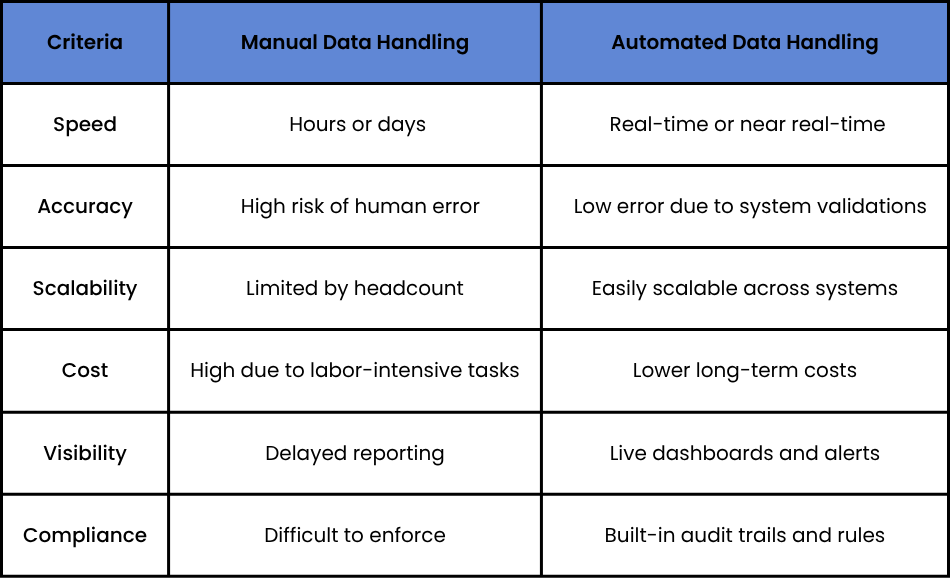
Manual data management can no longer support the scale and complexity of modern enterprises. Automated processes not only solve for efficiency but also open the door to data-driven innovation.
Key Benefits of Data Automation
Improved Accuracy
Automation removes the risk of human errors in data entry, calculation, or transformation. With consistent workflows, businesses ensure that every data point is treated the same way, every time. This is particularly important in sectors like finance, healthcare, and logistics, where errors can be costly or even dangerous.
Time and Cost Efficiency
Automating repetitive tasks like report generation, data reconciliation, or alerts saves hundreds of man-hours per month. Teams can redirect effort toward higher-value activities like analysis, strategy, and innovation. Over time, automation reduces the total cost of ownership (TCO) across systems and departments.
Real-Time Decision Making
In an era where timing can make or break a business decision, data automation empowers teams with up-to-the-minute insights. Real-time dashboards, KPIs, and alerts enable faster responses to opportunities or risks. Infoveave's real-time boards and conditional expressions make this actionable without additional tools.
Scalability
Data volumes are growing exponentially. Manual processes cannot keep up. Automation ensures that as your data sources and business processes grow, your systems can scale without proportional increases in operational workload.
Enhanced Compliance and Governance
With automation, audit trails, access controls, and data classification become embedded in the workflow. This ensures better alignment with data governance policies and regulatory requirements like GDPR, HIPAA, or ISO 27001.
Common Use Cases for Data Automation
Marketing Automation
- Sync CRM data with campaign platforms in real time
- Trigger emails based on lead scores, behavior, or campaign milestones
- Automatically generate and share performance dashboards across teams
- Personalize marketing content using real-time customer data from web, email, and social
Finance and Accounting
- Automate invoice processing with OCR and rule-based matching
- Detect anomalies or potential fraud using AI-driven workflows
- Reconcile accounts daily instead of monthly
- Auto-generate compliance reports with updated figures and audit trails
IT and Data Engineering
- Create and manage ETL pipelines for ingestion and transformation
- Monitor logs and system performance for outages or anomalies
- Trigger backups, alerts, or patches based on event thresholds
- Orchestrate workflows across cloud, hybrid, or on-prem systems
E-Commerce and Retail
- Update inventory levels across channels automatically
- Push real-time pricing changes to websites and marketplaces
- Sync customer behavior data into CDPs for personalization
- Automate promotional campaign triggers based on sales trends
Popular Tools for Data Automation in 2025
No-Code and Low-Code Platforms
- Zapier: Best for simple, multi-app integrations and automation
- Make (Integromat): Visual scripting and conditional logic for business users
- Power Automate: Native integration with Microsoft 365 and Azure stack
These tools allow non-technical users to build powerful automations without writing code, making data automation accessible to marketing, sales, and ops teams.
Enterprise Solutions
- Apache Airflow: Workflow orchestration and dependency management
- Alteryx: Advanced data prep, blending, and analytics automation
- UiPath: RPA for automating desktop and browser-based tasks
- Talend: ETL, data quality, and integration platform with governance support
- Infoveave: Unified Data Platform that automates end-to-end data workflows including data collection, processing, validation, and real-time visualization with in-built AI, data governance, and low-code configuration
Enterprise-grade platforms offer advanced features such as version control, scheduling, API integrations, and support for complex pipelines.
AI-Powered Automation
- AI models assist in tagging, categorization, anomaly detection, and prediction
- Natural Language Processing (NLP) to convert user prompts into workflows
- Reinforcement learning to adapt workflows based on feedback
- Platforms like Infoveave integrate AI through Fovea, enabling users to trigger data pipelines, generate dashboards, and summarize data through natural language queries
Best Practices for Implementing Data Automation
Identify Repetitive Tasks
Start with low-risk, repetitive tasks that consume a lot of time. Examples include monthly reporting, system health checks, or campaign performance updates. Prioritize use cases that show early ROI.
Ensure Data Quality
Data automation amplifies existing issues if not addressed upfront. Ensure that data inputs are clean, validated, and structured. Use data quality tools to set rules, monitor metrics, and highlight anomalies before automating workflows.
Start Small, Scale Fast
Deploy automation in phases. Run pilot projects with clearly defined goals and stakeholders. Once proven, replicate the framework across departments with scalable architectures.
Align with Data Governance Strategy
Integrate automation with your organization’s data governance tools. Use metadata management, access controls, and data lineage to track and manage automated workflows. Infoveave’s in-built data governance capabilities make it easier to manage compliance while scaling automation.
Monitor and Optimize
Automation is not a set-it-and-forget-it initiative. Monitor system performance, track success metrics (time saved, cost reduction, error rates), and refine workflows based on changing business needs.
Future of Data Automation
AI-Driven Automation
In the future, AI will play a central role in making automation intelligent. AI models will:
- Predict workflow dependencies and recommend automations
- Auto-generate data summaries for decision-makers
- Detect data quality issues in real time
- Trigger escalations or resolutions without human intervention
Infoveave's AI assistant Fovea is a step in this direction, enabling conversational automation, contextual data insights, and adaptive workflows.
Hyperautomation
Hyperautomation is the convergence of multiple automation technologies (RPA, AI, ML, process mining, and integration tools) into a single, intelligent system. It enables businesses to automate across the entire enterprise, from front-end interfaces to backend systems.
This reduces fragmentation, improves efficiency, and offers unified visibility. Platforms like Infoveave support hyperautomation by combining data apps, process automation, AI models, and data governance into one unified framework.
Data Governance Integration
As data privacy and compliance become stricter, future automation systems will need to be tightly integrated with data governance capabilities:
- Automated tagging of sensitive data
- Role-based access controls for workflows
- Built-in regulatory compliance checks (GDPR, HIPAA, SOC2)
- Version-controlled audit trails
Infoveave's approach ensures governance is not an afterthought but a foundational layer of all automated processes.
Conclusion
The business world of 2025 demands speed, accuracy, and resilience. Data automation delivers all three. From accelerating reporting cycles to enabling intelligent decision-making, automated data processes are critical to staying competitive.
Infoveave's Unified Data Platform is designed to help enterprises unify their data, simplify complex workflows, and amplify outcomes through automation, AI, and governance. Whether you're automating ETL pipelines, real-time dashboards, or last-mile data collection, Infoveave provides the tools to scale with confidence.
Don’t wait for inefficiencies to cost you growth. Start by identifying your top data automation opportunities today. Let Infoveave help you modernize your data architecture, streamline operations, and make every decision count.
Explore the Platform
About the Author
Smitha Bopanna
Smitha Bopanna is a contributor to the Infoveave blog, specialising in data analytics, unified data platforms, and enterprise AI. Infoveave (by Noesys Software) helps organisations unify data, automate business processes, and act faster with AI-powered insights.
Ready to see Infoveave in action?