From Patient Flow Visibility to Intelligent Patient Flow Orchestration — a practical guide to the problem, workflow, architecture, and implementation framework for healthcare practitioners (2026)
Patient Flow Expediter (noun) — An intelligence and coordination layer across hospital operational states, dependencies, tasks, and capacity constraints that answers who is waiting, why they are waiting, what is blocking movement, which action would help most, and who needs to act next — without replacing the hospital's systems of record.
This guide is for:
Hospital operations and patient-flow leaders responsible for ED boarding, bed turnover, and capacity across units
Clinical and bed-management teams who own placement, transfers, and competing demand for scarce beds
Healthcare IT and analytics leaders connecting EHR, ADT, EVS, transport, and transfer systems into one operational picture
If your hospital can see where patients are but not why they are stuck — or which single action would unblock the most beds — this framework applies.
~50%
Nearly half of EDs report operating at or above capacity (AHRQ)
9 in 10
Hospitals report boarding admitted patients in the ED awaiting inpatient beds (AHRQ)
5
Practical questions the Expediter answers: who's waiting, why, what's blocking, which action, who acts
One principle holds throughout: the Expediter recommends, it doesn't decide. It surfaces the blocker, traces the dependency chain, and points to the highest-leverage option — but authority to act, especially when patients compete for the same scarce bed, stays with the clinical or operational team.
Hospitals have never had more operational data.
And the consequences keep piling up. AHRQ's patient-flow research found that nearly half of EDs are operating at or above capacity, and nine in ten hospitals are boarding admitted patients in the ED simply because there's no inpatient bed ready for them.
The real challenge isn't seeing where patients are. It's understanding why they're stuck, and where the next bottleneck is about to form.
EHRs, ADT, bed management, patient-flow platforms, transfer centers, EVS, transport, staffing, diagnostics, pharmacy — each one holds a piece of the picture. But having all that data doesn't mean a hospital can actually see why a patient is stuck, understand what that delay is doing downstream, or know which single action would unblock the most beds.
This is the gap the Patient Flow Expediter is built to close. It isn't meant to be another system of record, and it's not a replacement for the tools the hospital already runs. Instead, think of it as an intelligence and coordination layer — something that sits across operational states, dependencies, tasks, and capacity constraints to answer five practical questions: Who's waiting? Why are they waiting? What's blocking movement? Which action would help the most? And who needs to act next? Depending on what it finds, the Expediter assesses the blocking dependency, coordinates the response across whichever departments are involved, and, when two or more patients are competing for the same constrained resource, helps reroute demand toward the next best option.
One principle holds throughout, and it's worth saying upfront: the Expediter recommends, it doesn't decide. At every step below, it surfaces the blocker, traces the dependency chain, and points to the highest-leverage option — but the actual authority to act, especially when patients are competing for the same scarce bed, stays with the clinical or operational team. We'll call this out explicitly wherever competing demand comes up, but it holds true throughout, not just in those moments.
1. The Patient Flow Problem: Visibility Is Not the Same as Flow Intelligence
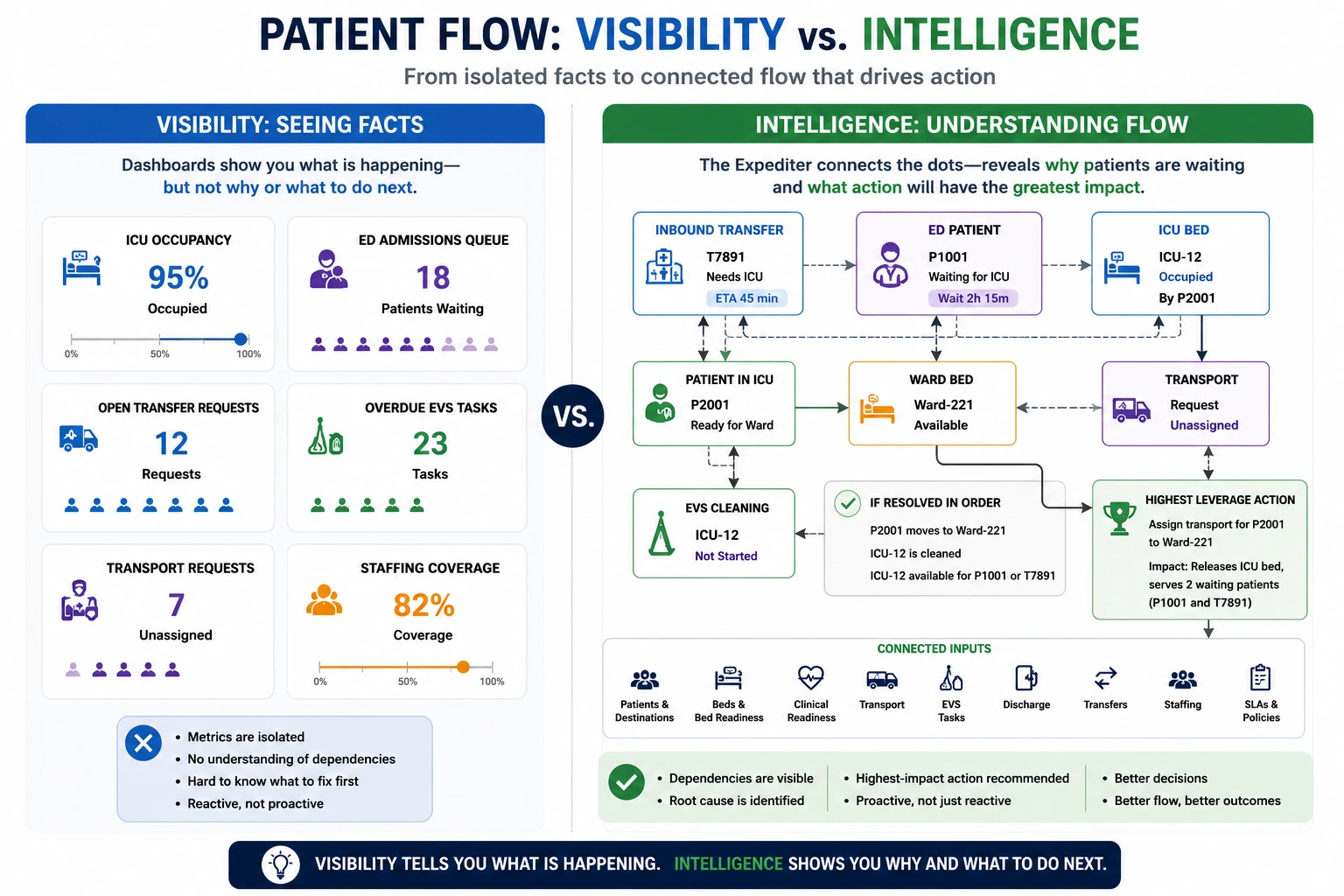
A dashboard can show you 95% ICU occupancy, a queue of ED patients waiting for admission, open transfer requests, overdue EVS tasks. Useful facts, all of them — but they don't tell you how those facts connect.
The pressure is also getting harder to ignore on paper. Recent hospital quality reporting initiatives have put more weight on ED boarding duration and length of stay for admitted patients — a sign that patient flow is turning into a system-level performance issue, not just an emergency department problem. CMS's Emergency Care Access & Timeliness measures explicitly track boarding beyond four hours and extended ED length of stay as quality gaps.
Patient flow is really a chain of dependent state transitions. A patient waiting for an ICU bed might not be blocked by a shortage of ICU beds at all — it could be that an ICU patient who's ready for the ward can't move because transport hasn't been assigned yet. Until that patient actually moves, the ICU bed can't be released, cleaned, or made ready for whoever's next.
So the Expediter focuses on movement, not isolated metrics. It connects patients, their intended destinations, beds, clinical readiness, bed readiness, transport, EVS, discharge, transfers, staffing, tasks, SLAs, and dependencies into one shared operational picture.
Patient flow is a chain of dependent state transitions. Managing it well requires seeing the chain — not just the metric at the end of it.
Related reading:Healthcare Analytics Solutions — how Infoveave unifies clinical and operational data for hospital networks.
2. The Expediter Workflow: Steps 1–5 — From Waiting Patient to Highest-Leverage Action
Step 1 — Determine the intended next movement
Start with the patient who's waiting, and work out where they're supposed to go next. Say P1001 is in ED-23, has an ICU disposition, is clinically ready, and is headed for ICU-12. The Expediter doesn't need to redo the clinical or placement work that got the patient here — it takes that existing state and builds decision context around it.
The key questions: Is the destination still the right one? Has a bed actually been identified? Is it available and physically ready? Is the receiving unit ready? Is transport available? Is something else in the way?
Step 2 — Identify the current blocker
Say ICU-12 is occupied by P2001, who's medically ready to go to the ward. Ward-221 is available, but nobody's picked up the transport request yet. So the real blocker here isn't ICU capacity — it's transport.
That distinction changes the whole response. It's no longer 'find an ICU bed' — it's 'clear the downstream transport dependency that's keeping an ICU bed from being released.'
Step 3 — Trace the dependency chain
Patient-flow bottlenecks are rarely one hop away. The Expediter needs to trace the chain far enough to find the constraint that's actually controlling movement:
P1001 is waiting for ICU admission.
ICU-12 is occupied by P2001.
P2001 is ready for the ward.
Ward-221 is available.
Transport hasn't been assigned yet.
P2001 can't move, so ICU-12 can't be released.
Even after release, ICU-12 still needs EVS cleaning before it can take P1001.
This is also where the physical world meets the digital workflow. Bed cleaning happens in the real world, and it usually starts in an EVS or bed-management process: a discharge or transfer changes the bed's status, a cleaning task gets created and assigned, a housekeeper does the work, and the task gets marked complete. The Expediter doesn't clean the bed. It watches the digital trail that process leaves behind, notices when a task is running late, connects that delay to the patients and capacity waiting on it, and can trigger an escalation or a recommendation.
Step 4 — Identify the highest-leverage action
The patient who's waited longest isn't always the right place to start. The Expediter looks at which action is likely to unlock the most flow or capacity overall, weighing clinical priority, safety, policy, and downstream impact along the way. In this example, assigning transport for P2001 could set off a chain reaction:
Transport P2001 → P2001 moves to Ward-221 → ICU-12 is released → EVS cleans ICU-12 → P1001 moves to ICU.
This is where decision intelligence earns its keep. Prioritization can weigh waiting time, acuity, SLA breaches, downstream dependencies, expected arrivals, transfer priority, capacity impact, and how many patients are actually affected.
Step 5 — Add inbound transfer intelligence alongside internal movement
Inbound transfers deserve their own treatment, because they bring an external demand stream into the same constrained capacity network. A transfer center might accept a high-priority cardiac ICU transfer from another hospital before an ICU bed is actually available. Meanwhile, an internal ICU patient might be clinically ready to move to an open ward bed — which could free up exactly the capacity that transfer needs.
This is where the Expediter's rerouting behavior kicks in: redirecting a patient, a bed, or a slice of capacity toward the next best option when the original path is blocked. Rerouting is never automatic when it involves competing patients, though — it's a recommendation the Expediter surfaces, not an allocation it makes.
Human-in-the-loop control for competing capacity
When an inbound transfer and an internal patient are competing for the same scarce capacity, the Expediter shouldn't be the one deciding who gets it. Instead, it flags the conflict, lays out the operational impact of each option, and routes the decision through the right approval or escalation workflow.
For example:
Inbound transfer T7891: Accepted, ICU required, high priority, awaiting bed.
P1001: ED patient ready for ICU admission, waiting 85 minutes.
P2001: ICU patient medically ready for ward transfer, waiting for transport.
Ward-221: Available and potentially able to receive P2001.
The Expediter can see the connected chain here: moving P2001 to Ward-221 could release an ICU bed, and that bed could then go to either P1001 or the inbound transfer T7891. But if both are competing for it, the Expediter isn't the one who decides.
Instead, the workflow could be:
Competing-capacity workflow
1Expediter detects capacity conflict
2Identifies competing patient demand
3Assesses dependencies and operational impact
4Presents relevant context and recommendations
5Escalates to the authorized decision-maker
6Human approval / prioritization decision — authority stays with the clinical or operational team
7Expediter initiates the approved workflow
8Monitors the outcome and reassesses capacity
This is a crucial human control point in the Expediter's architecture. The system provides the intelligence needed to make a good decision; the authorized clinical or operational team keeps control over how scarce capacity actually gets allocated.
The same principle holds for internal movement across ED, ICU, wards, OR/PACU, imaging, and everywhere else. The Expediter follows the patient's journey and its dependencies, not just whichever department happens to own the task in front of it.
Human Control Point
When patients compete for scarce capacity, the Expediter flags, explains, and escalates — it does not allocate. Authority stays with the clinical or operational team.
See Patient Flow Intelligence in Action
Book a demo to see how Infoveave unifies EHR, ADT, bed, EVS, and transport signals into a governed patient-flow picture — with dependency tracing, escalation workflows, and human approval on competing capacity.
3. Steps 6–7 — From Reactive Intelligence to Predictive Intelligence and Orchestration
Step 6 — Predict the next bottleneck
Once the Expediter has a handle on the current state and the dependency network, it can go beyond explaining today's blockers to predicting tomorrow's.
Predictive scenario snapshot
Live signal
What it means
ICU occupancy at 92% + ED arrivals rising
Very limited shock-absorption capacity for the next admission wave
Four high-acuity patients expected within one hour
Near-term ICU demand likely to outpace available ready beds
Two ICU discharges planned, but EVS turnaround is slowing
Bed-release timeline risk increases even if clinical discharge is complete
Transport requests are piling up
Downstream movement delays can block both expected discharges and incoming admissions
A useful prediction doesn't just say 'ICU capacity will be constrained.' It explains why: one expected discharge may be waiting on a delayed downstream discharge, while the other is at risk from slowing EVS turnaround.
So predictive intelligence needs to combine the current state with historical patterns and forward-looking signals: expected arrivals, planned discharges, transfer demand, task aging, transport queues, service-time trends. And every prediction needs its confidence level, assumptions, and drivers attached — otherwise a forecast is just another alert nobody trusts.
Deep dive:Fovea — Infoveave's Agentic AI — how Fovea interprets composite operational signals, surfaces risks before they materialise, and initiates governed workflows.
Step 7 — Orchestrate the response
The Expediter's real value isn't spotting a problem. It's helping coordinate the response while keeping the right amount of human control in place.
In practice, that's a closed loop: detect an overdue task → assess its patient and capacity impact → predict what happens if it stays unresolved → recommend the highest-impact intervention → kick off the right workflow → watch what happens.
↺ The output of Step 6 feeds back into Step 1 for the next cycle.
Depending on how the hospital's set up, orchestration might mean creating or updating an EVS escalation, notifying the EVS supervisor or bed manager, escalating an unassigned transport request, alerting the transfer center, or updating an expected bed-availability estimate.
Automation boundary
Generally safe to automate
Should stay human-led (unless explicitly approved)
Notifications
Clinical acceptance decisions
Task creation
Clinical prioritization
SLA escalation
Transport prioritization between competing patients
Workflow triggers
Discharge sequencing
Status updates and monitoring loops
Bed assignment, safety-critical decisions, and exception handling
Not everything should be automated. Use automation for repeatable coordination actions; keep high-risk, competing-demand, and policy-sensitive decisions under accountable human oversight unless your hospital has explicitly signed off on a different model.
Platform module:Infoveave Data Automation — orchestrate governed workflow triggers, escalation paths, and operational task coordination across hospital systems.
This is the inflection point at which patient-flow tooling stops being a visibility layer and starts being an operational intelligence and orchestration platform.
4. How the Expediter Fits With Existing Hospital Systems
The Expediter doesn't need to replace any of these systems.
Architecture principle
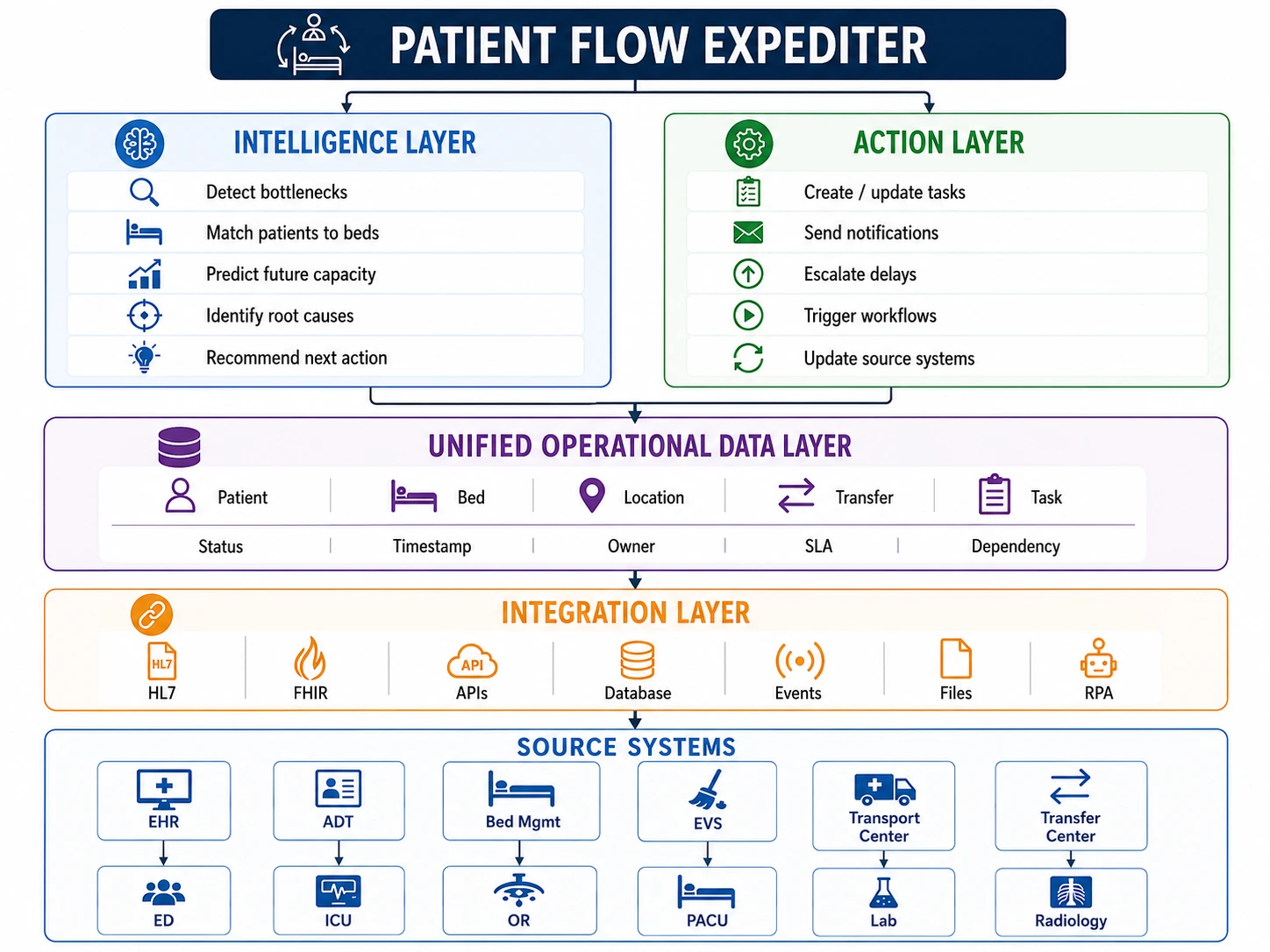
That's central to the whole architecture. Hospitals already have systems of record and systems of action for clinical care, patient movement, beds, transfers, EVS, transport, diagnostics, pharmacy, staffing, and everything else. The Expediter connects to those systems, pulls the relevant information into a shared patient-flow context, reasons across the dependencies, and coordinates action through the systems that already do the work.
The systems and integration methods below are meant to ground the idea in real hospital infrastructure, not act as a spec. If you're reading this from a clinical or operational seat, the main point to take away is that the Expediter connects to what already exists rather than replacing it — you don't need to follow every system named to get that.
A practical architecture is:
Existing hospital systems: EHR/EMR, ADT, hospital management, bed management, patient-flow platforms, transfer center, EVS, transport, ED, ICU, OR/PACU, lab, radiology, pharmacy, staffing.
Integration and interoperability: HL7, FHIR, APIs, database interfaces, event streams, files, or RPA where legacy systems leave no better integration path.
Unified patient-flow context: common representations of patients, encounters, locations, beds, transfers, tasks, owners, SLAs, dependencies, and outcomes.
Patient-flow intelligence: diagnosis, dependency tracing, impact analysis, prioritization, and prediction.
Decision and orchestration: recommendations, notifications, escalations, task creation, and workflow initiation.
Existing systems of action: the operational systems where work is ultimately performed and recorded.
One caution worth flagging: integration alone doesn't create a reliable operational model. Getting there means resolving identity matching, location and bed normalization, event timing, duplicate or conflicting statuses, stale data, missing timestamps, and ownership ambiguity, and deciding which system is authoritative for each state. A bed might be 'vacant' in one system, 'dirty' in another, and 'unavailable' in a third, all at the same time. The Expediter needs explicit precedence and reconciliation rules; it can't just assume the latest message is the correct one. And this isn't only a technical concern: a recommendation is only as trustworthy as the state it's reasoning over, so it should be treated as decision support to check against real-world bed and patient status, not as a standalone instruction to move someone.
So the distinction is this: integration gets information out of existing systems. Unification turns it into one common operational model. Intelligence interprets how those facts relate to each other. Orchestration initiates or coordinates the response.
The Trust Barrier
A recommendation is only as trustworthy as the state it's reasoning over. Precedence and reconciliation rules are not optional when systems disagree on bed or patient status.
Related guide:What Is a Unified Data Platform? — how unification, governance, and orchestration reinforce each other in one environment.
5. Building the Patient Flow Expediter: A Practical Technical Framework
What follows is a rough outline of what sits underneath the Expediter — a sense of the moving parts, not a build spec or implementation roadmap.
The Patient Flow Expediter works best as a cross-system operational intelligence layer — not another standalone dashboard, and not a replacement for what the hospital already runs. Its job is to bring together the operational signals generated across the hospital, build a common view of patient movement and capacity, understand how they depend on each other, and coordinate the right response.
A practical implementation can be built around six capabilities:
Step one is getting reliable connections to the systems generating patient-flow events and operational states.
These may include:
EHR / EMR: Patient and encounter information, clinical disposition, orders, and relevant readiness indicators
ADT systems: Admissions, discharges, transfers, and location changes
Bed management: Bed assignment, availability, occupancy, readiness, and status
Transfer center: Transfer requests, acceptance, priority, destination requirements, and expected arrival
EVS: Cleaning task creation, assignment, completion, and turnaround times
Transport: Requests, assignment, pickup, and completion
ED and inpatient units: Patient arrivals, boarding, movement, and readiness
OR / PACU: Procedure schedules, recovery status, and downstream bed demand
Diagnostics: Imaging and laboratory dependencies that may delay movement
Staffing systems: Unit staffing and operational constraints that affect usable capacity
The goal isn't just integration, though. The Expediter needs to capture the events and state changes that actually influence patient movement, and catch them quickly enough to support real operational decisions.
For example:
Patient discharged → Bed becomes vacant → EVS task created → EVS task assigned → Cleaning completed → Bed marked ready → Next patient moved
The Expediter needs to see this chain as it's happening, not after the fact.
Depending on what the hospital already has, integration might use HL7, FHIR, APIs, database interfaces, event streams, files, or RPA for older applications. The architecture should support real-time events where possible, and fall back to scheduled updates where it isn't.
Related:Data Ingestion — connecting hospital and operational source systems into a governed foundation.
2. Normalize the Data Into a Common Patient-Flow Model
Integration by itself doesn't create intelligence.
Different systems often describe the same thing differently. One might call a bed "vacant," another "dirty," another "unavailable" — all at the same moment. A transfer system might show a patient as accepted while bed management hasn't found them a suitable bed yet.
So the Expediter needs a common operational model: one set of consistent definitions and relationships that everything maps back to.
At a minimum, this model should represent:
Patient: Patient and encounter identifiers, current location, and relevant clinical or operational priority indicators
Movement: Current location, intended destination, movement type, and movement status
Bed: Unit, room, bed, specialty or capability, availability, and readiness
Transfer: Source organization, destination, acceptance status, priority, and expected arrival
Task: Task type, owner, creation time, assignment, SLA, and completion
Dependency: The task, condition, or event preventing a movement from occurring
Capacity: Current availability and capacity expected to become available
Decision: Recommendation, approval, decision, timestamp, and outcome
That's what creates a shared operational context — the thing that lets the Expediter actually understand how systems relate to each other.
For example:
P1001 is waiting for an ICU bed.
ICU-12 is occupied by P2001.
P2001 is ready for Ward-221.
Ward-221 is available.
Transport for P2001 is unassigned.
Inbound transfer T7891 has also been accepted and requires ICU capacity.
Without that common model, the Expediter is just a collection of integrated dashboards. With it, the platform can actually reason about how one state affects another.
3. Build a Real-Time Patient-Flow State Model
The Expediter should keep a live operational state for every patient journey, updating it continuously as new events come in.
For each patient, the system should be able to establish:
Where the patient is now
Where the patient is expected to go next
How long the patient has been waiting
Whether the destination is available
What is preventing movement
Which task or dependency needs to be resolved
Which other patients or capacity constraints are affected
For example:
Current state: ED
Next intended state: ICU
Destination: ICU-12
Wait time: 85 minutes
Immediate blocker: ICU-12 occupied
Downstream dependency: P2001 awaiting transport
Potential unlock: Ward-221 available
Capacity conflict: Inbound transfer T7891 also requires ICU capacity
Decision required: Prioritization of competing demand
That's what turns individual events into a state someone can actually act on.
The state model should also hold onto timestamps and transitions, so the Expediter understands not just what is happening now, but how the situation developed.
Over time, this creates a historical record of:
How long patients spend in each stage of their journey
How long tasks remain unassigned
How long beds remain unavailable
Where delays repeatedly accumulate
Which dependencies create recurring bottlenecks
Which interventions consistently improve patient movement
That historical context is what predictive intelligence gets built on.
4. Create a Dependency and Impact Model
This is where the Expediter starts doing something conventional patient-flow dashboards can't.
Patient movement should be represented as a network of connected dependencies:
From there, the Expediter can trace the downstream impact of that immediate blocker.
In this example:
Unassigned transport request → delays P2001's movement → prevents ICU-12 from being released → delays ICU admission for P1001 → may affect the hospital's ability to accommodate inbound transfer T7891 → increases the risk of further patient-flow delays
That's the critical distinction. The Expediter isn't just flagging that transport is overdue. It's showing why that overdue task matters to the wider patient-flow network.
The dependency model also lets the Expediter tell the difference between a task that's simply late and one that's a capacity-critical bottleneck holding up several downstream movements at once.
5. Introduce Decision Intelligence and Human Approval
Once the operational state and dependency model are in place, the Expediter can start weighing possible interventions.
For each possible action, the system can assess factors such as:
Patients affected
Waiting time
Relevant clinical priority indicators available to the system
Capacity potentially released
Downstream movements unlocked
SLA or escalation risk
Expected future demand
Transfer priority
Operational constraints
The Expediter can then generate a recommendation such as:
Recommended action: Assign transport to P2001.
Expected impact: Enable movement to Ward-221 and potentially release ICU-12 after bed turnover.
Downstream impact: Creates ICU capacity for one of two competing demands — ED admission P1001 or inbound transfer T7891.
Decision required: Authorized patient-flow or clinical leader to prioritize competing demand.
This introduces an important design principle:
The Expediter can automate the analysis without necessarily automating the decision.
Where a decision touches competing patients, scarce capacity, clinical priority, safety, or policy exceptions, it should go through a proper human approval workflow.
The decision itself should get captured as part of the operational record, too:
That creates an audit trail, and it also lets the organization learn over time which recommendations and interventions actually move the needle on patient flow.
6. Orchestrate Actions Through Existing Systems
The last piece is moving from intelligence to coordinated action.
Once an intervention's approved — or falls within predefined automation rules — the Expediter can kick off the right operational workflow.
Examples include:
Creating or escalating an EVS task
Escalating an overdue transport request
Notifying a bed manager or patient-flow team
Alerting a transfer center to a developing capacity constraint
Requesting confirmation of bed readiness
Initiating a workflow for competing capacity
Updating expected bed availability
Notifying downstream teams
Reassessing the patient-flow state after an action is completed
The Expediter shouldn't turn into the place where every task actually gets done. The existing systems should keep executing and recording the work they were built to manage.
The principle is simple
Existing systems execute the work. The Expediter coordinates the work.
That protects the hospital's existing technology investment, while adding an intelligence layer that can see across departmental boundaries.
Related:Data Automation — how Infoveave initiates governed workflows from operational signals without replacing systems of action.
A Practical Example: From Raw Events to Coordinated Action
Consider a real-time scenario:
1. Event ingestion
ADT reports:
P1001 → ED-23 → ICU disposition
Bed management reports:
ICU-12 → occupied by P2001
The clinical system indicates:
P2001 → medically ready for ward transfer
Bed management reports:
Ward-221 → available
The transport system reports:
P2001 transport → unassigned for 35 minutes
The transfer center reports:
T7891 → accepted → ICU required → awaiting bed
2. State interpretation
The Expediter determines:
ICU capacity is constrained.
P1001 is waiting for ICU admission.
P2001 is preventing ICU-12 from being released.
Transport is the immediate operational blocker.
T7891 creates competing future demand for the same ICU capacity.
3. Dependency analysis
The Expediter sees that assigning transport to P2001 could let the patient move to Ward-221 and, eventually, free up ICU-12.
4. Decision intelligence
The system flags that the resulting ICU capacity might be needed by two competing demands: P1001, an internal ED admission, and T7891, an accepted inbound transfer.
5. Human control
The Expediter escalates the competing-capacity decision to the authorized decision-maker, laying out the relevant patient-flow context, dependencies, priorities, and potential operational impact.
6. Orchestration
Once the decision's approved, the Expediter kicks off the right workflow — coordinating transport, EVS, bed readiness, and patient movement through the hospital's existing systems.
7. Closed-loop reassessment
Then the cycle repeats. As new events come in and the operational state shifts, the Expediter keeps reassessing patient movement, capacity, dependencies, and whether further intervention is needed.
What you end up with is an operational intelligence capability that does more than report where patients are. It understands why they're waiting, identifies what's constraining movement, helps decision-makers weigh competing demands, and coordinates the actions needed to keep patients moving.
Infoveave is built for this class of problem. It's a Unified Data Platform that brings data ingestion, governed operational models, workflow automation, real-time monitoring, and Fovea — its Agentic AI — into one environment. For healthcare teams, that means EHR, ADT, bed, EVS, transport, and transfer signals can connect into one shared patient-flow context — with human approval preserved where competing capacity demands it.
Frequently Asked Questions
Q: What is a Patient Flow Expediter?
A Patient Flow Expediter is an intelligence and coordination layer that sits across hospital operational systems — EHR, ADT, bed management, EVS, transport, transfer centers, and more — to answer five practical questions: Who's waiting? Why are they waiting? What's blocking movement? Which action would help the most? And who needs to act next? It recommends and orchestrates; it does not replace systems of record or make clinical allocation decisions on its own.
Q: How is a Patient Flow Expediter different from a patient flow dashboard?
A dashboard can show ICU occupancy, ED boarding queues, open transfer requests, and overdue EVS tasks as isolated facts. An Expediter connects those facts into dependency chains — for example, showing that an ED patient waiting for ICU is actually blocked by unassigned transport for a medically ready ICU patient who could free that bed. Visibility describes; flow intelligence explains and points to the highest-leverage action.
Q: Does a Patient Flow Expediter replace the EHR or bed management system?
No. The Expediter is not another system of record and is not a replacement for EHR/EMR, ADT, bed management, patient-flow platforms, transfer centers, EVS, or transport. It connects to those systems, builds a shared patient-flow context, reasons across dependencies, and coordinates action through the systems that already execute and record the work.
Q: Who decides when two patients compete for the same bed?
The Expediter recommends; it does not decide. When an inbound transfer and an internal patient compete for scarce capacity, the Expediter flags the conflict, lays out operational impact, and routes the decision through the authorized clinical or operational approval workflow. Human-in-the-loop control remains with the clinical or operational team.
Q: What are the seven steps of the Expediter workflow?
Steps 1–5 move from a waiting patient to the highest-leverage action: determine intended next movement, identify the current blocker, trace the dependency chain, identify the highest-leverage action, and add inbound transfer intelligence. Steps 6–7 shift from reactive to predictive: predict the next bottleneck, then orchestrate the response while keeping human control where competing capacity, clinical priority, or safety is involved.
Q: Which hospital systems does the Expediter connect to?
A practical architecture connects EHR/EMR, ADT, bed management, patient-flow platforms, transfer center, EVS, transport, ED, ICU, OR/PACU, lab, radiology, pharmacy, and staffing — via HL7, FHIR, APIs, database interfaces, event streams, files, or RPA where legacy systems require it. Integration alone is not enough; the Expediter also needs precedence and reconciliation rules when systems disagree on bed or patient state.
Q: How does Infoveave support patient flow intelligence?
Infoveave brings together data ingestion, governed operational models, workflow automation, real-time monitoring, and Fovea in a single Unified Data Platform. Healthcare teams can unify EHR, ADT, bed, EVS, transport, and transfer signals into a shared patient-flow context — then detect blockers, escalate workflows, and keep human approval on competing capacity decisions.
6. Conclusion — The Shift From Visibility to Orchestration
The Patient Flow Expediter earns its value by closing the gap between operational visibility and coordinated action. It doesn't need to replace the hospital's EHR, ADT, bed management, patient-flow, transfer, EVS, or transport systems — its job is to connect the signals those systems already generate and read them as one patient-flow network.
The progression is straightforward, really: understand who's waiting, figure out why, trace the dependency, find the highest-impact intervention, anticipate what gets constrained next, and coordinate the response. That's the shift — from dashboards that describe the hospital to an intelligence layer that helps it act.
Success isn't measured in screens or alerts. It's whether the hospital can cut avoidable waiting, clear bottlenecks faster, get more out of the capacity it already has, coordinate internal and inbound patient movement, and learn which interventions actually, consistently, improve flow.
The goal is not another screen that shows where patients are. It is an intelligence layer that makes the hospital faster — because every blocker is explained, every recommendation is grounded in a shared operational model, and every scarce-capacity decision stays under human control.
Build Patient Flow Orchestration with Infoveave
See how Infoveave unifies hospital operational data sources, governs patient-flow context, monitors bottlenecks in real time, and activates Fovea's agentic intelligence — with human approval where competing capacity demands it.
This article was produced by the Infoveave Product and Solutions Team — specialists in Unified data platforms, agentic BI, and enterprise analytics. Infoveave (by Noesys Software) helps organizations unify data, automate business process, and act faster with AI-powered insights.